Masih bingung harus mulai dari mana? IHRH hadir untuk membantu tenaga kesehatan mengenal peluang remote healthcare, belajar keterampilan baru, dan menyiapkan langkah menuju karir global.
Komunitas & platform edukasi untuk membantu tenaga kesehatan Indonesia mengenal peluang, belajar secara bertahap, dan membangun kesiapan untuk berkontribusi di dunia remote healthcare.
Menjadi ekosistem terpercaya yang mempersiapkan tenaga kesehatan agar mampu bersaing dalam lanskap kesehatan digital global dengan kompetensi yang kuat, integritas, dan tujuan yang bermakna.
Kami menyediakan ruang tumbuh yang utuh, mulai dari kegiatan belajar terstruktur, buku digital, hingga komunitas profesional yang siap saling mendukung.
Tingkatkan keahlian secara praktis melalui Webinar, Mini Course, Bootcamp dan Sesi Mentoring interaktif seputar dunia Medical Virtual Assistant..
Akses koleksi bacaan dan workbook eksklusif yang dirancang khusus untuk memandu langkah demi langkah persiapan karier remote healthcare Anda.
Terhubung langsung dalam group WhatsApp interaktif untuk networking dan berbagi insight industri.
Mau dapat Passive Income? Yuk, gabung Program Affiliate IHRH Academy! Dapatkan hingga 10% dari setiap pendaftaran Webinar atau pembelian buku digital lewat Link Referral kamu.
Daftar webinar dan mini course yang diselenggarakan oleh IHRH.
Tingkatkan keahlian remote healthcare Kamu melalui koleksi panduan, workbook, dan modul bacaan ekslusif.
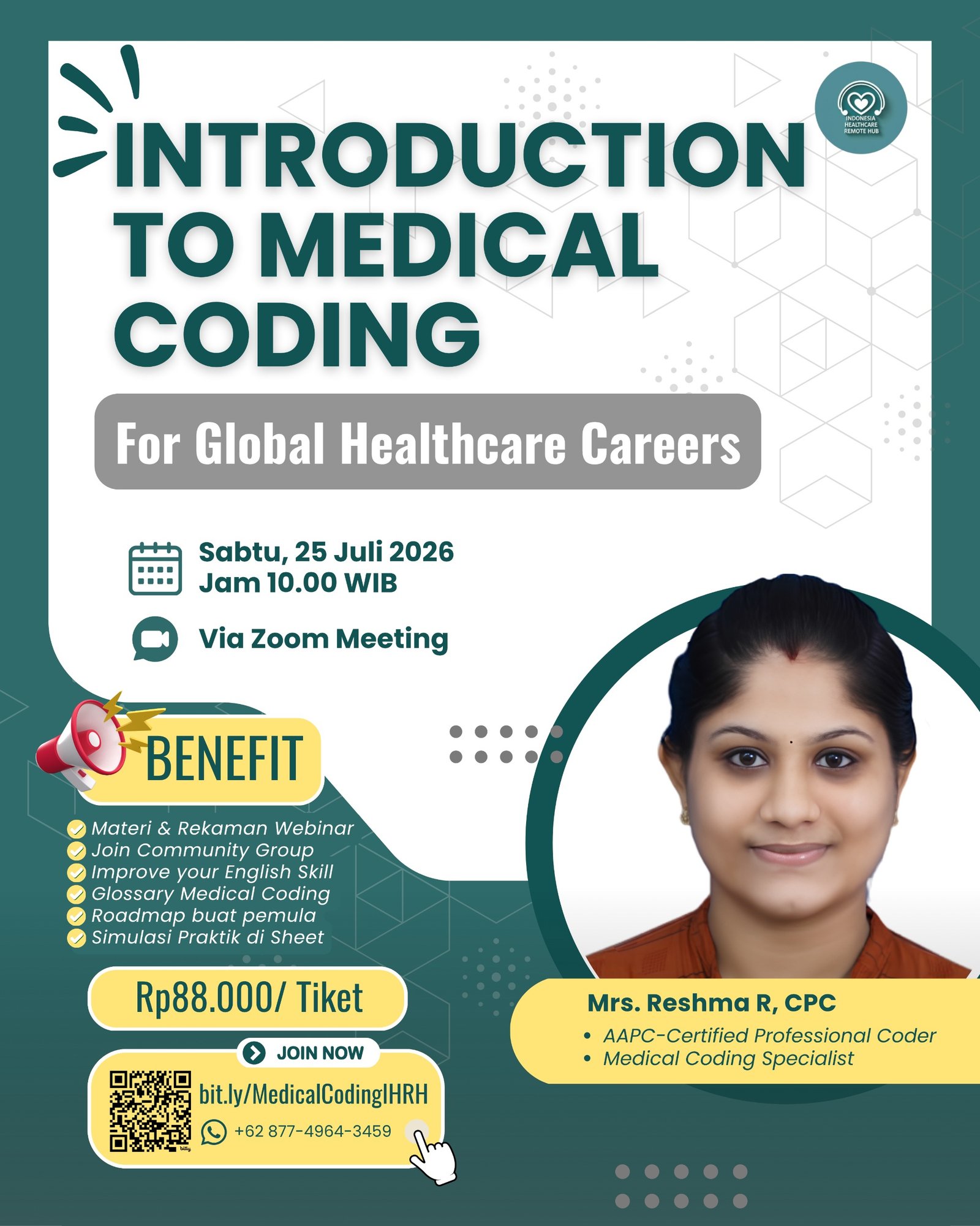
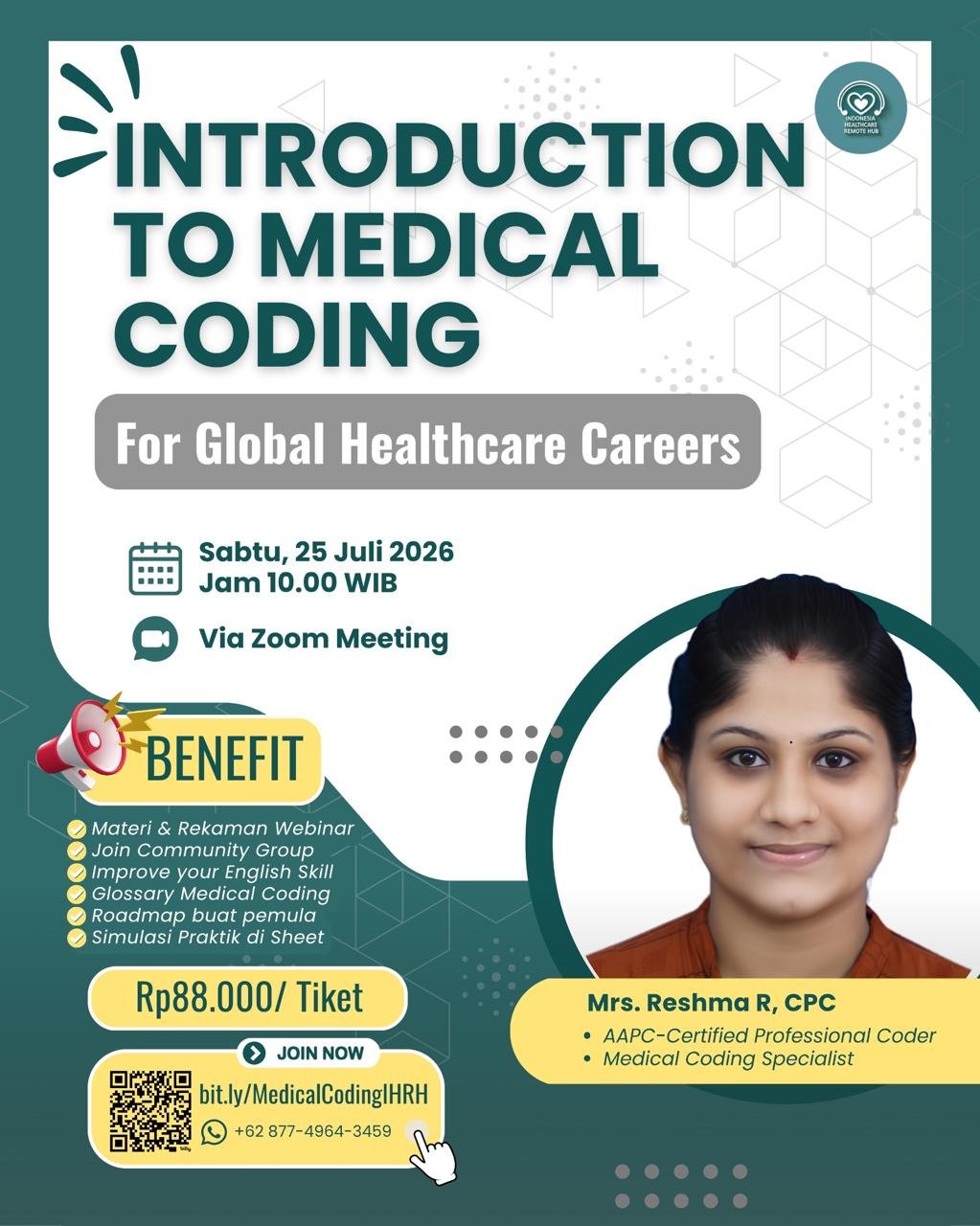
Isi Paket: Rekaman Zoom Webinar + Materi Webinar + Bonus: Roadmap Belajar, Glossary, Simulasi Praktik Sheet dan Akses Komunitas IHRH Pernah dengar Medical Coding, tapi masih bingung sebenarnya profesi ini ngapain? π§ Tahukah kamu? Medical coding termasuk salah satu skill yang paling banyak dicari di dunia healthcare global, karena membantu mengubah catatan klinis menjadi data standar yang digunakan dalam dokumentasi, pelaporan, dan workflow layanan kesehatan internasional. Lewat rekaman webinar bersama Mrs. Reshma R, CPC, kamu akan diajak memahami langkah awal memulai karir di bidang Medical Coding secara taktis dan terarah. Materi & Benefit yang Akan Kamu Pelajari: β Dasar-Dasar Medical Coding: Memahami konsep, fungsi, dan perannya dalam industri healthcare global. β Roadmap Belajar & Glossary: Panduan alur belajar yang terstruktur beserta istilah-istilah penting (glossary). β Simulasi Praktik Sederhana: Praktik langsung menggunakan sheet untuk gambaran kerja nyata. β Akses Komunitas: Grup komunitas untuk diskusi dan melanjutkan proses belajar. Semua ini dirancang agar Sobat Nakes lebih siap membuka peluang karir di dunia healthcare internasional. Jangan tunggu sampai ketinggalan! Persiapkan skill-mu dari sekarang. π Siap upgrade skill dan mulai membangun karir globalmu? Isi formulir pendaftaran di bawah ini untuk mengamankan paket rekaman dan akses bonusnya sekarang! πβ¨
English for MVA dirancang khusus untuk membantu tenaga kesehatan Indonesia membangun kemampuan bahasa Inggris kerja dengan cara yang mudah, praktis, dan menyenangkan. Lengkap dengan rekaman audio dan script percakapan nyata persis seperti yang digunakan MVA saat bekerja! Di sini, kamu akan belajar bahasa Inggris yang benar-benar dipakai di dunia nyata, seperti: - Berkomunikasi lancar via telepon - Menangani penjadwalan tanpa ragu - Melakukan verifikasi data pasien dengan akurat - Menggunakan penyampaian yang jelas, profesional, dan ramah (patient-centered) Kabar baiknya: Kamu nggak wajib punya bahasa Inggris yang flawless atau accent sempurna untuk mulai! Yang terpenting adalah functional English, yaitu kemampuan menyampaikan pesan dengan jelas, tepat, dan percaya diri saat melayani pasien serta bekerja sama dengan tim. Saatnya ubah rasa ragu jadi percaya diri. Mari buka jalan karier barumu dengan mempelajari English for MVA!
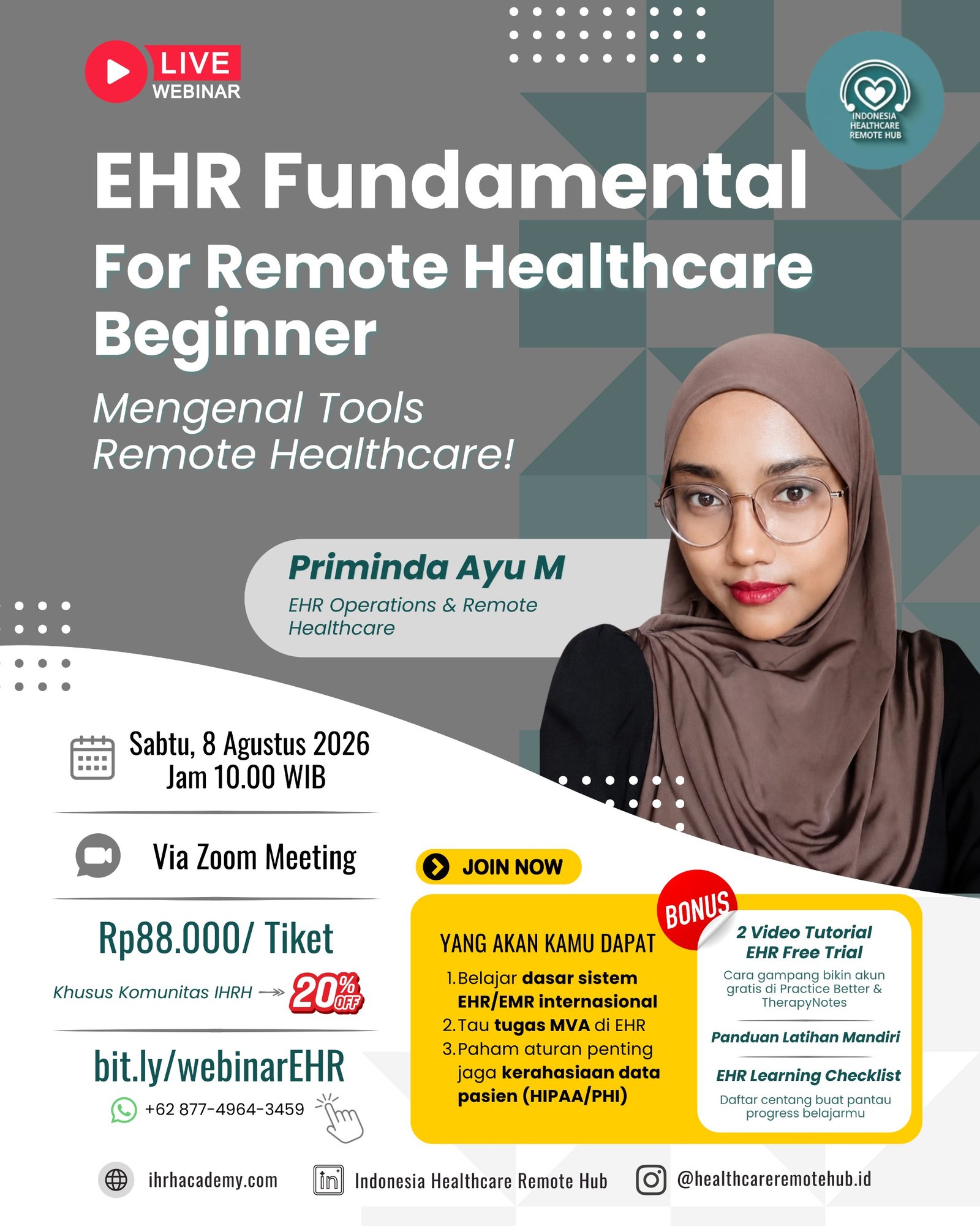
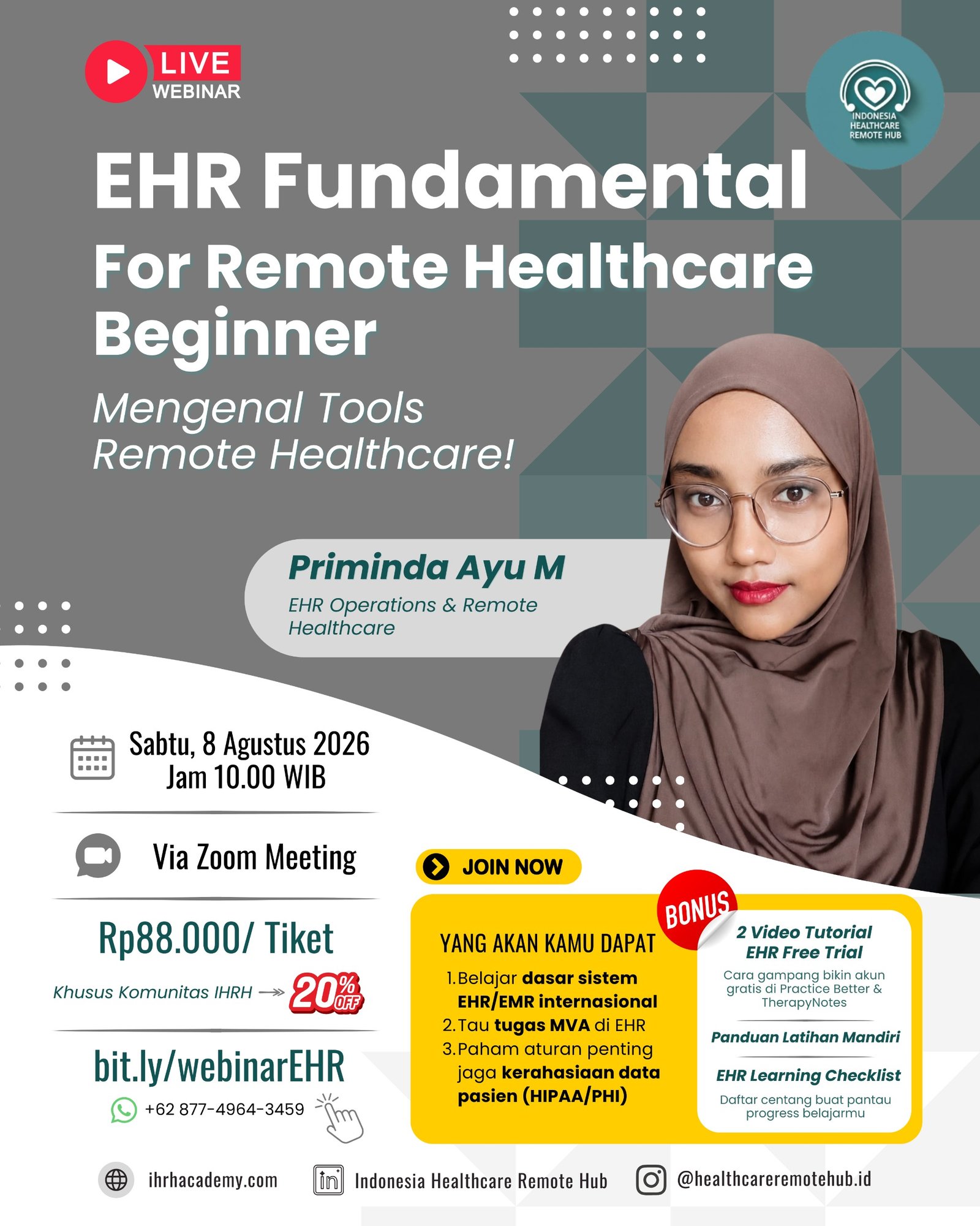
Isi Paket: Record Zoom Webinar + Materi Webinar + Bonus Video Tutorial & EHR Learning Checklist Kalau belum kenal EHR, peluang kerja remote bisa terasa jauh. Padahal, semua bisa dipelajari dari dasar! Salah satu skill yang paling sering dicari dalam dunia Remote Healthcare adalah kemampuan memahami Electronic Health Record (EHR/EMR). Lewat rekaman webinar ini, kamu akan diajak mengenal konsep dasar EHR, memahami bagaimana sistem ini digunakan dalam layanan kesehatan internasional, hingga mengetahui peran Medical Virtual Assistant (MVA) dalam mengelola dokumentasi pasien secara profesional. Materi yang Akan Kamu Pelajari: - Dasar Sistem EHR/EMR Internasional: Memahami konsep, alur kerja, dan penggunaan EHR di pasar global. - Peran MVA dalam Penggunaan EHR: Menguasai tugas serta tanggung jawab Medical VA dalam mengelola dokumentasi medis. - Kerahasiaan Data Pasien (HIPAA/PHI): Memahami pentingnya menjaga privasi dan keamanan data kesehatan pasien. Jangan tunggu sampai ada lowongan baru belajar! Persiapkan skill-mu dari sekarang agar lebih siap menghadapi peluang remote healthcare global.
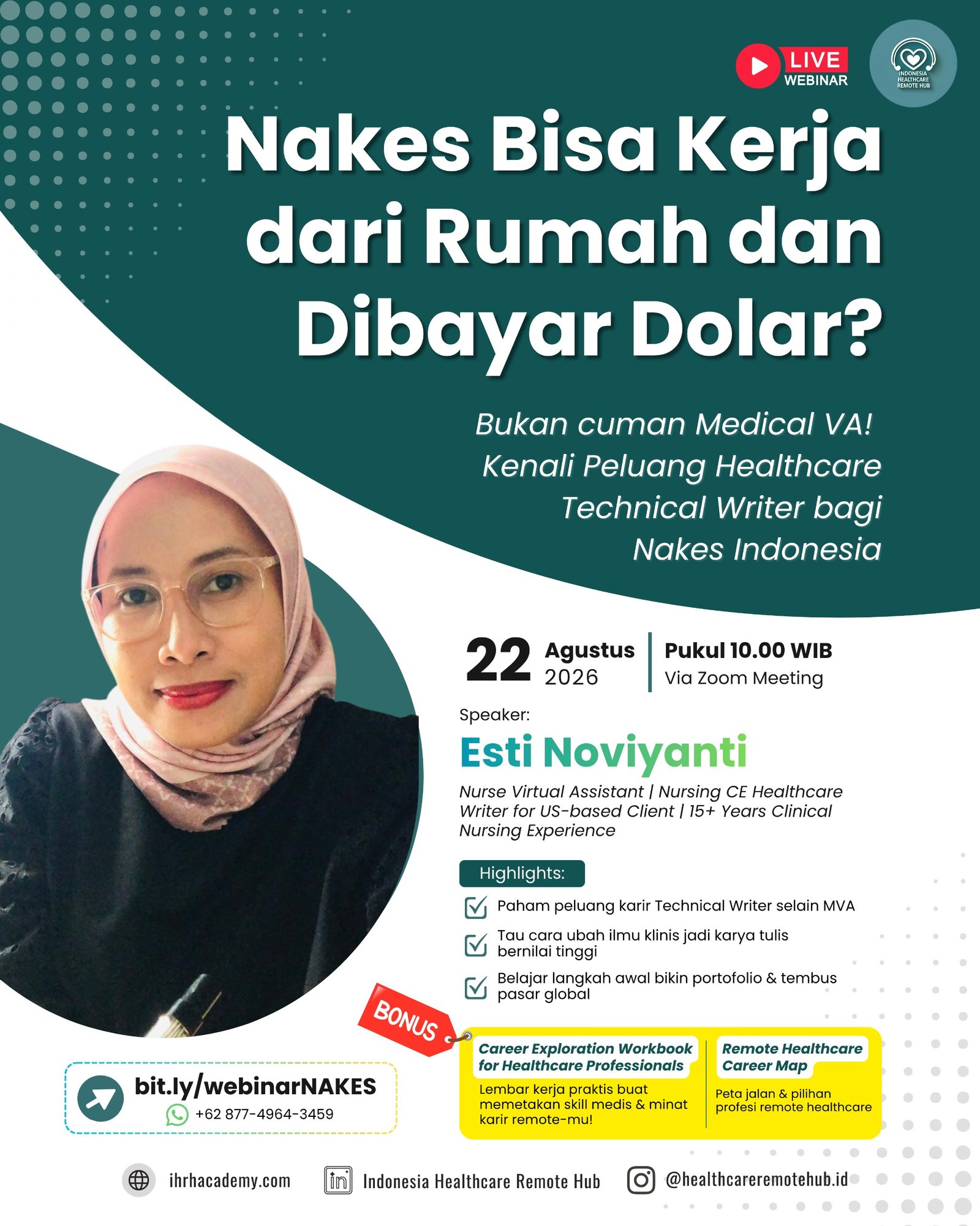
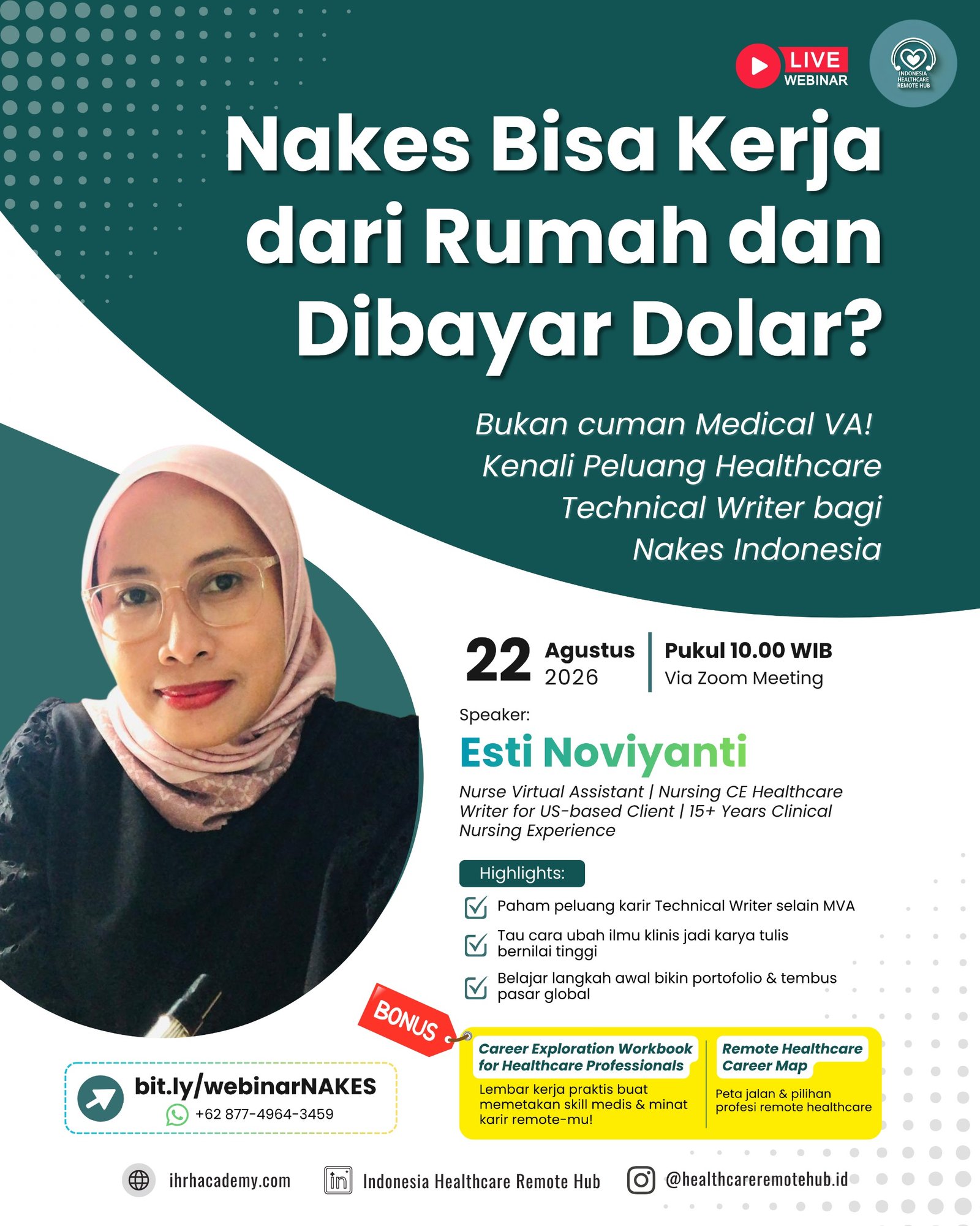
Isi Paket: Record Zoom Webinar + Materi Webinar + Bonus Career Exploration Workbook for Healthcare Professionals Lewat rekaman webinar ini, kamu akan membedah peluang profesi Healthcare Technical Writer, sebuah peran yang memungkinkan Nakes mengubah pengalaman dan pengetahuan klinis menjadi karya tulis bernilai tinggi untuk pasar global. Materi yang Akan Kamu Pelajari: Mengenal Profesi Technical Writer: Memahami ruang lingkup kerja dan potensi kariernya di industri kesehatan global. Mengubah Ilmu Klinis Menjadi Karya Tulis: Cara mengolah latar belakang medis menjadi tulisan yang teknis, rapi, dan profesional. Membangun Portfolio dari Nol: Langkah praktis menyusun portofolio tulisan agar dilirik oleh klien internasional. Menembus Pasar Kerja Global: Strategi dan peluang untuk mulai berkarier secara remote. Dapatkan rekaman webinarnya sekarang dan mulailah mengembangkan kariermu jauh lebih jauh di dunia remote healthcare!
Informasi seputar remote healthcare untuk kamu!.
Esti Noviyanti, S.Kep.
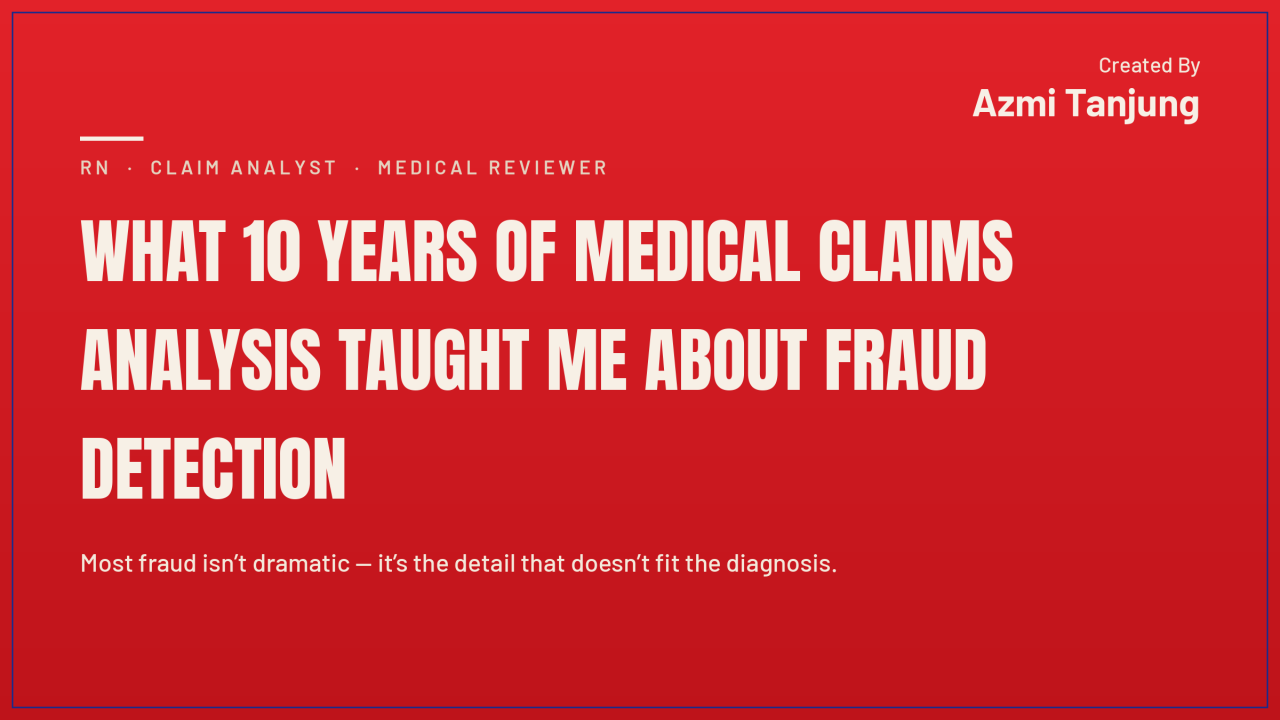
Trainer Insight: Medical VA Insurance Support This article is contributed by Azmi Tanjung Health Insurance Claims Specialist | Registered Nurse (RN) | 10+ Years in Medical Claims Analysis, Utilization Review & Fraud Detection | Cashless Claims, Case Management, Claims Adjudication | Remote β Globa When people hear "insurance fraud," they picture something dramatic β a staged accident, a fabricated hospital stay, an organized ring. In ten years of reviewing medical claims, those cases were the rare exception. Most of what erodes a health insurer's integrity is far quieter: small mismatches, padded bills, and pre-existing conditions that quietly went undeclared. The damage is real, but it rarely announces itself. Here is what a decade of reading claims β first at a hospital helpdesk, then as a claim analyst β taught me about spotting it. The clearest signal is mismatch If I had to teach one thing to a new reviewer, it would be a single question: does the treatment fit the diagnosis? A patient admitted for dengue does not usually need a thyroid panel. When a request for a test like TSH or FT4 turns up on a dengue claim, that is not fraud by itself β but it is a flag. Either the documentation is incomplete, or someone is rounding out the bill with services the diagnosis doesn't justify. Most of the leakage I saw was not invented illness; it was real admissions with extra items bolted on. Train yourself to notice what doesn't belong, and you catch the majority of it. Timing tells a story Waiting periods exist for a reason, and that reason is human nature. A cancer that surfaces within weeks of a policy being issued, a chronic condition like diabetes or hypertension diagnosed inside the first year, a serious illness appearing right as a waiting period closes β these patterns repeat because conditions that "appear" the moment coverage starts were often present long before it. This is not about assuming bad faith. It is about recognizing that the timing of a diagnosis is itself information. A claim that lands suspiciously early deserves a closer look at when the condition first began, not just when it was reported. Watch the detail that doesn't belong Some of the most useful findings were incidental. A patient comes in with a fever, but the admission workup shows a blood pressure of 180/100 and elevated blood sugar. The fever may be entirely real β yet those readings hint at an undisclosed chronic condition sitting quietly behind an acute claim. Clinical training is what makes this visible. A checklist sees "fever, covered." A clinician sees a number that doesn't fit the picture and asks why. That instinct β pulling the thread on the one data point that's out of place β is where a nurse's background becomes an investigative advantage. Validate the narrative, not just the numbers For accident claims especially, the story has to hold together. A fracture from slipping in the bathroom, or from a motorcycle fall where the rider had a valid license and wore a helmet, fits a clean clinical picture. When the mechanism of injury, the radiology, and the rest of the examination don't line up, that gap is exactly where you investigate. Fraud detection is as much about coherence as it is about figures. If the clinical evidence, the chronology, and the documentation tell three different stories, one of them is wrong. Declining is not the goal β verifying is This is the lesson I most want honest reviewers to hear: an anomaly is a reason to verify, not to reject. The large majority of unusual claims turn out to be legitimate once you have the full picture. So when something looked off, the right move was rarely a flat denial. It was to request the medical records, ask for an attending physician statement, or run a deeper investigation β and then to reopen or refund the moment the evidence cleared the patient. Protecting the fund and treating policyholders fairly are not opposing goals. Done well, fraud detection defends the honest majority, because every rupiah lost to leakage is a rupiah that should have reached a real claim. The real lesson Ten years in, I stopped thinking of fraud detection as catching bad actors. It is closer to disciplined pattern recognition layered on top of clinical knowledge: does the treatment match the diagnosis, does the timing make sense, does the story cohere β and have I verified before I decided? The rules engines and AI tools we use are excellent at flagging the obvious. But the subtle cases, the ones that matter most, still come down to a trained eye asking a simple question: does this make medical sense? I'm always glad to compare notes with others working in claims, utilization review, and medical underwriting. The patterns are remarkably consistent across markets β and the clinical lens travels well.
Baca Selengkapnya
Esti Noviyanti, S.Kep.
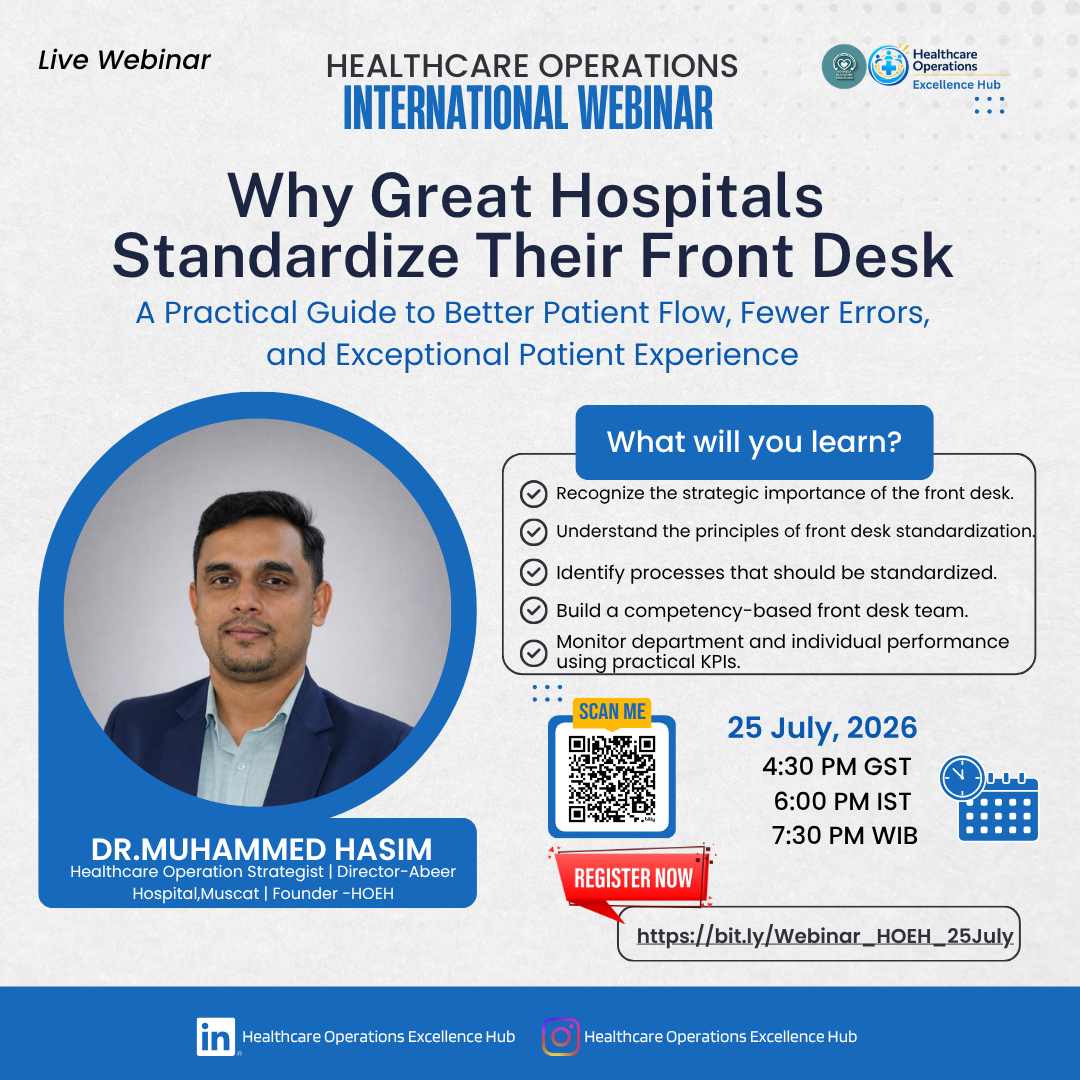
Reducing Revenue Leakage in Healthcare with Medical Virtual Assistants Guest Author: Dr. Muhammed Hasim Healthcare Operations Consultant, Hospital Director, and Process Improvement Specialist GCC Healthcare Systems In healthcare, financial losses do not always come from major system failures. More often, they happen quietly through small operational gaps that go unnoticed but continue to drain revenue over time. Missed documentation, delayed insurance approvals, unbilled services, and follow-ups that never happen may seem minor on their own. But when these issues accumulate across the patient journey, they can cost healthcare organizations significant revenue. This is where Medical Virtual Assistants (MVAs) can make a meaningful difference. Understanding Revenue Leakage in Healthcare Revenue leakage refers to revenue that should have been earned but is never captured, billed, or collected because of inefficiencies in processes and workflow management. Common sources of revenue leakage include: 1. Incorrect or incomplete patient registration 2. Missing insurance information or eligibility errors 3. Services provided but not billed 4. Documentation gaps that affect claim submission 5. Delayed or missed pre-authorizations 6. Poor follow-up on rejected or pending claims These are not always clinical problems. In many cases, they are operational issues that directly affect financial performance. The Hidden Cost of Inefficient Processes Many healthcare organizations focus heavily on increasing patient volume. However, growth without strong process control often creates even more challenges. Without efficient systems in place, healthcare providers may experience: 1. Higher claim rejection rates 2. Delayed billing cycles 3. Lost revenue opportunities 4. Staff overload and burnout In many situations, the issue is not a lack of patient activity. The real problem is the inability to convert that activity into revenue efficiently. How Medical Virtual Assistants Help Reduce Revenue Leakage Medical Virtual Assistants can strengthen operational workflows and support the revenue cycle in practical and measurable ways. 1. Accurate Patient Registration and Insurance Verification The revenue cycle begins long before billing. Errors at the registration stage can create financial problems later in the process. MVAs help by ensuring: - Accurate entry of patient demographic information - Real-time insurance eligibility checks - Proper verification of coverage and policy details This reduces front-end errors and helps prevent claim denials later. 2. Pre-Authorization and Documentation Support Delayed pre-authorizations are one of the most common causes of service delays, patient drop-offs, and unbilled procedures. MVAs can support this process by: - Initiating and tracking pre-authorizations - Coordinating with insurance companies - Ensuring documentation is complete and ready for submission With better coordination and timely follow-up, healthcare organizations can reduce disruptions and improve service continuity. 3. Charge Capture and Billing Accuracy One of the most overlooked causes of revenue leakage is simple but costly: services are delivered, but not properly documented or billed. MVAs can help by: - Supporting timely charge entry - Cross-checking services provided against documentation - Helping ensure that no billable service is missed This improves billing accuracy and protects revenue that has already been earned. 4. Claims Submission and Follow-Up Rejected or delayed claims are not only financial setbacks. They also point to weaknesses in process management. MVAs can contribute by: - Tracking claim status - Managing resubmissions - Following up with insurers - Helping reduce turnaround time (TAT) Consistent follow-up can improve collections and minimize preventable losses. 5. Patient Communication and Conversion Support In outpatient settings, many services are never completed simply because patients do not receive clear guidance or timely follow-up. MVAs can support patient communication by: - Explaining procedures and administrative requirements - Clarifying cost-related information - Following up on pending appointments or services This helps improve service completion rates and reduces lost revenue opportunities. Operational Impact of Medical Virtual Assistants When integrated effectively, Medical Virtual Assistants can contribute to meaningful operational improvements, including: 1. Reduced claim rejection rates 2. Faster billing cycles 3. Improved cash flow 4. Higher service-to-billing conversion 5. Better coordination across departments 6. Reduced workload for front-desk and clinical teams These outcomes show that MVAs are not only administrative support staff. They can also become important contributors to financial sustainability. MVAs Are Not Just Support Staff, but Strategic Assets Healthcare organizations often view virtual assistants as a cost-saving solution. In reality, their role can go much further. Medical Virtual Assistants can function as revenue-protection partners by helping healthcare teams close operational gaps before they become financial losses. The difference lies in mindset: 1. Cost-based view: MVAs are seen only as support staff 2. Strategic view: MVAs are recognized as revenue enablers Organizations that adopt the second perspective are more likely to unlock the full value of this role. Why Proper Training Matters Revenue cycle processes are complex. An untrained assistant may increase errors, while a properly trained Medical Virtual Assistant can help improve both operational and financial performance. Effective training should include: 1. Insurance workflows and payer requirements 2. Documentation standards 3. Billing and coding fundamentals 4. Communication protocols 5. Process discipline and accountability The quality of training directly influences the quality of the outcomes. Final Thought Revenue leakage is not always visible, but it is often present. The answer is not simply to bring in more patients. It is to build better processes that protect the value of every service already delivered. Medical Virtual Assistants can play a critical role in closing operational gaps, protecting revenue, and improving efficiency across healthcare systems. As remote healthcare roles continue to grow, Medical Virtual Assistants are becoming increasingly valuable, not only as administrative support, but also as part of a more efficient and financially sustainable healthcare system.
Baca Selengkapnya
Esti Noviyanti, S.Kep.
Healthcare is one of the most complex operational environments in the world. Behind every patient consultation lies a network of administrative coordination, documentation, scheduling, insurance processing, communication, and data management. While clinical teams focus on patient care, a significant portion of healthcare operations depends on administrative efficiency. When these processes slow down, the impact is immediate longer waiting times, delayed decisions, staff burnout, and operational inefficiencies. This is where Virtual Assistants (VAs) are becoming an increasingly valuable asset in healthcare operations. The Growing Administrative Burden in Healthcare Modern healthcare organizations deal with enormous administrative workloads. Hospitals and clinics manage: Appointment scheduling Patient communication Medical documentation Insurance coordination Data entry and reporting Follow-up reminders Operational dashboards Studies consistently show that clinicians and administrators spend a large percentage of their time on non-clinical administrative tasks. This not only reduces productivity but also diverts focus away from patient care. Healthcare leaders are now exploring smarter ways to manage these operational demands. Virtual assistants provide one of the most effective solutions. Where Virtual Assistants Add Value in Healthcare Virtual assistants can support healthcare organizations in several operational areas. 1. Appointment and Patient Communication Management Missed appointments and inefficient scheduling are common challenges in healthcare. Virtual assistants can handle: Appointment confirmations Patient reminders Follow-up calls Rescheduling coordination This improves patient attendance and reduces revenue loss from missed appointments. 2. Administrative Documentation Support Documentation is a major operational burden in hospitals and clinics. Virtual assistants can assist with: Data entry Record organization Documentation formatting Report preparation By reducing documentation workload, healthcare professionals gain more time to focus on patient care. 3. Insurance and Billing Coordination Insurance verification and claims processing are time-consuming tasks. Virtual assistants trained in healthcare administration can help with: Insurance eligibility verification Claims documentation support Billing coordination Payment follow-ups This improves revenue cycle efficiency and reduces delays. 4. Operational Reporting and Dashboard Support Healthcare leaders rely on operational metrics to monitor performance. Virtual assistants can support teams by preparing: Daily operational reports Patient flow dashboards Appointment conversion reports Data summaries for management reviews Access to structured data enables faster and better decision-making. 5. Digital Presence and Patient Engagement In todayβs digital environment, healthcare organizations must maintain strong online engagement. Virtual assistants can manage: Social media communication Website updates Patient inquiries Online appointment requests This helps healthcare providers stay responsive and accessible to patients. The Strategic Advantage of Virtual Assistants The value of virtual assistants is not only cost efficiency it is operational focus. When administrative workload is streamlined, healthcare teams can focus more on: Patient care Clinical decision-making Operational improvement Strategic growth For healthcare leaders, this creates a more sustainable and efficient healthcare system. Preparing Virtual Assistants for Healthcare Healthcare operations require accuracy, confidentiality, and structured processes. Virtual assistants supporting healthcare organizations should be trained in: Healthcare communication etiquette Data privacy and confidentiality Documentation accuracy Process discipline Basic healthcare workflow understanding Training institutions such as Virtual Assistant Academy play a critical role in preparing professionals for these responsibilities. The Future of Healthcare Operations Healthcare systems worldwide are under pressure to deliver better care with greater efficiency. Technology, automation, and remote support models are transforming how administrative work is managed. Virtual assistants are becoming an essential part of this transformation by helping healthcare organizations maintain operational efficiency without increasing administrative burden. For healthcare leaders, the question is no longer whether virtual assistants can support healthcare operations, but how effectively they can be integrated into the system. Author Dr. Muhammed Hasim Healthcare Operations Consultant Hospital Director | Process Improvement Specialist GCC Healthcare Systems
Baca SelengkapnyaIntip keseruan belajar dan berkembang bareng para Sobat Nakes Indonesia Healthcare Remote Hub di sini!
Dokumentasi Kegiatan
Grow Together Live Session with Vincent Petersen (MSV) Mastering the Interview: Communicating Your Value with Confidence
Baca selengkapnya!
Dokumentasi Kegiatan
Grow Together Live β Expert Session Topic: Storytelling for Healthcare Professionals Grow and Glow Through Words: Creating Meaningful Content from Healthcare Experience
Baca selengkapnya!
Dokumentasi Kegiatan
Grow Together Live: Inside the World of Medical Insurance From Diagnosis to Claim Approval Learn directly from a medical insurance professional about the claim workflow, ICD-10, and remote career opportunities for HVAs.
Baca selengkapnya!
Dokumentasi Kegiatan
IHRH: Grow Together Live Boosting Clinical Operations with EMR: Practical Skills for Healthcare Virtual Assistants
Baca selengkapnya!
Dokumentasi Kegiatan
Community Live Session β Coffee Talk with Clinical Psychologist Judul: "Mental Sehat Awal Karir HVA: Solusi Beyond Burnout untuk Tetap Bahagia dan Produktif" Narasumber: Dr. Yulisa Susanti, M.Si., M.Psi, Psikolog
Baca selengkapnya!
Dokumentasi Kegiatan
IHRH: Grow Together Live Expert Session: Personal Branding for Healthcare VA
Baca selengkapnya!Pertanyaan yang sering diajukan oleh Sobat Nakes seputar Remote Healthcare.